AI Agents vs AI Chatbots: What Should Your Business Use in 2026?
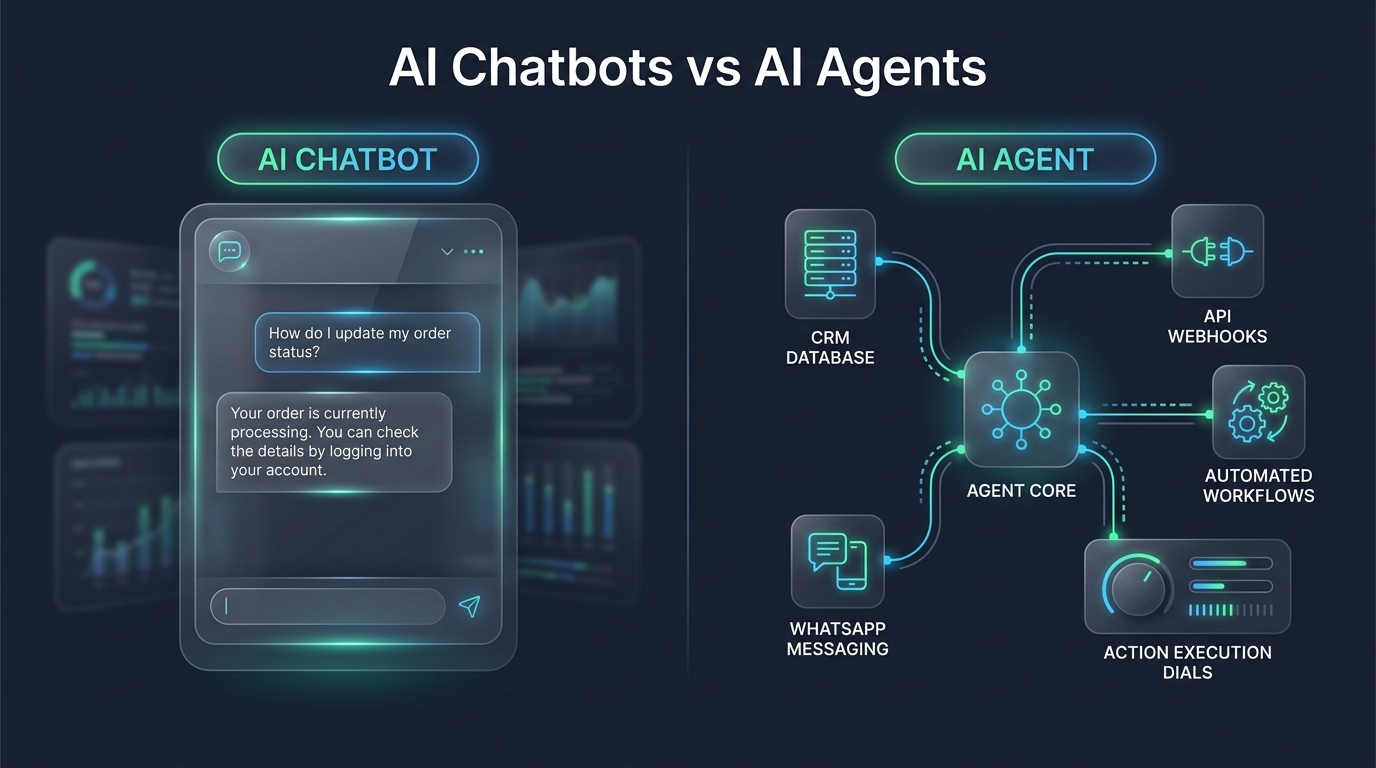
AI Agents vs AI Chatbots: What Should Your Business Use in 2026?
By SoftClinch Consulting Services | 12 min read
Businesses in 2026 are moving past experimental AI novelties toward practical operational systems. Customers expect instant, personalized answers at any hour of the day. Sales leadership demands that high-intent leads receive automated qualification and immediate follow-ups. Operations managers are eager to eliminate repetitive manual data entry, disparate software silos, and delayed handoffs.
As leadership teams evaluate artificial intelligence to drive efficiency, an important architectural question has surfaced across executive meetings:
Is your business looking for an AI system that answers questions, or one that can actually perform tasks and take action?
This distinction represents the fundamental difference between AI Chatbots and AI Agents. While both technologies leverage modern artificial intelligence, their underlying capabilities, operational autonomy, and business impact differ dramatically.
What Is an AI Chatbot?
An AI chatbot is a conversational software interface designed to dialogue with users, understand natural language questions, and deliver helpful, relevant answers in real time.
Modern AI chatbots represent a massive evolution from the rigid, button-based decision trees of the past. Powered by Large Language Models (LLMs) and advanced Natural Language Processing (NLP), today’s chatbots can interpret nuanced phrasing, handle typos, summarize product documentation, and maintain conversational context across an entire dialogue.
Core Capabilities of Modern AI Chatbots
- Conversational Q&A: Answering questions based on pre-configured knowledge bases, company websites, and documentation.
- 24/7 Customer Support: Resolving recurring first-tier queries regarding business hours, service offerings, policies, and pricing tiers.
- Top-of-Funnel Lead Capture: Gathering names, email addresses, phone numbers, and basic requirement summaries from website visitors.
- Product & Service Recommendations: Guiding potential buyers through service catalogs or eCommerce storefronts.
- Channel Accessibility: Engaging customers across websites, mobile apps, and business messaging apps like WhatsApp.
- Human Escalation: Gracefully handing off complex or sensitive inquiries to human agents when an answer falls outside the knowledge base.
A Realistic Business Example
A potential client visits your company website and types into the chat window:
“Do you provide SAP implementation services in Chennai, and what modules do you support?”
A well-configured AI chatbot immediately understands the inquiry. It draws from your service documentation to confirm that your team provides SAP implementation and AMS support across Chennai and Tamil Nadu, highlights core modules like SAP FICO, MM, and SD, and politely asks if the user would like to leave their contact number for a consultation.
Where Chatbot Limitations Emerge
The chatbot performs admirably as an information provider. However, suppose the customer responds:
“Great. Book a discovery call with your SAP solutions architect for this Thursday at 3 PM, create an inquiry file in your CRM with my requirement, and send a WhatsApp confirmation to my phone.”
This is where a traditional AI chatbot hits its ceiling. By default, a conversational chatbot does not authenticate with calendar APIs, query database availability, write records into a CRM, or trigger multi-step communication pipelines. It is built to converse, not to execute.
---
What Is an AI Agent?
An AI agent is an autonomous software system designed to accomplish a specific objective by reasoning, breaking goals into operational steps, utilizing connected tools and APIs, and executing multi-step actions across business systems.
Where a chatbot operates primarily as a conversational interface, an AI agent functions as a digital task executor. When given an objective, an AI agent does not merely generate text; it analyzes the environment, determines what actions are required, calls external software tools, observes the results of those actions, and iterates until the goal is achieved.
Key Capabilities of an AI Agent
- Goal-Oriented Reasoning: Understands high-level objectives rather than just responding to isolated text prompts.
- Autonomous Multi-Step Planning: Determines the logical sequence of operations needed to fulfill a complex request.
- Tool and API Integration: Connects directly with CRMs, ERPs, databases, scheduling tools, messaging gateways, and payment processors.
- Data Retrieval and Verification: Queries internal business systems to fetch live data (e.g., stock levels, order statuses, or calendar openings).
- Direct System Actions: Creates, updates, modifies, and deletes records across enterprise applications without requiring manual human data entry.
- Closed-Loop Workflow Execution: Validates whether each step succeeded before moving to the next operational phase.
A Realistic Business Example
Consider an enterprise application development agency receiving an inbound inquiry:
“I need a custom ERP built for our textile manufacturing unit in Coimbatore. We have 120 employees and need inventory, production, and GST invoicing integrated. Please connect me with your solutions team.”
An AI agent deployed on the website or WhatsApp Business channel handles this scenario fundamentally differently:
- Analyzes Intent and Scope: Identifies the industry (textile manufacturing), location (Coimbatore), team size (120), and required functional modules (inventory, production, GST invoicing).
- Checks Data Completeness: Detects that the prospect’s company name and preferred consultation timeframe are missing, and automatically asks a polite follow-up question.
- Validates & Scores the Lead: Classifies the inquiry as a high-value enterprise custom development opportunity based on scope and company size.
- Interacts with CRM: Automatically generates a new company record and deal in the CRM, tags it with the appropriate industry and budget tier, and logs the entire requirement transcript.
- Assigns Domain Expert: Queries team schedules and assigns the deal to the senior ERP solutions architect overseeing manufacturing clients in Western Tamil Nadu.
- Dispatches WhatsApp Confirmation: Calls the official WhatsApp Business Platform API to send the prospect a verified confirmation with a personalized consultation booking link.
- Initiates Automated Follow-Up: Queues an internal notification for the account executive and schedules an automated check-in if the consultation link remains unclicked after 24 hours.
The defining characteristic of an AI agent is not merely superior conversational fluency; it is action, tool use, and operational autonomy.
---
AI Chatbot vs AI Agent: Key Differences
To help business owners and decision-makers quickly compare both approaches, the table below outlines the core technical and operational distinctions:
| Feature / Dimension | AI Chatbot | AI Agent |
|---|---|---|
| Primary Purpose | Conversing, answering questions, delivering information | Achieving specific business goals through autonomous actions |
| Nature of Interaction | Conversational, turn-by-turn dialogue | Goal-driven, multi-step workflow execution |
| Decision-Making | Predicts the best text response based on language models | Evaluates options, determines next operational steps, and adapts |
| Tool & API Usage | Limited or read-only (retrieves articles/links) | Active read/write integration with APIs, databases, and software |
| Workflow Execution | Single-step conversational responses | Multi-step sequential or parallel business workflows |
| CRM Integration | Often basic (passes contact name/email via webhook) | Deep bi-directional read/write (creates leads, updates stages, logs notes) |
| WhatsApp Integration | Automated replies, menu selection, FAQ answers | Dynamic conversational workflows, order tracking, CRM sync, scheduling |
| Lead Management | Collects basic contact details | Scores, enriches, classifies, and routes leads to specific team members |
| Customer Support Scope | Answers common questions, guides to help articles | Resolves tickets, modifies account settings, processes returns, updates orders |
| Human Handoff | Routes chat to an available agent when confused | Prepares full briefing, logs CRM data, and alerts human only when needed |
| Level of Autonomy | Low (strictly conversational boundary) | High (operates independently within defined safety guardrails) |
| Technical Complexity | Moderate (faster setup, standard prompts/RAG) | Advanced (requires API integrations, state management, validation logic) |
| Implementation Timeline | Days to a few weeks | Several weeks depending on system integration depth |
| Best Suited For | Customer support FAQs, website guidance, basic lead capture | Complex operations, CRM automation, automated sales pipelines, ERP tasks |
---
Simple Example: Chatbot vs Agent in Action
To understand how this plays out in daily business reality, let's examine a scenario that occurs thousands of times every day across service companies and B2B enterprises:
A prospect submits an inquiry:
“I want a custom ERP for my manufacturing company. Can someone contact me?”
The Traditional AI Chatbot Journey
- The chatbot acknowledges the message: “Thank you for your interest! We build custom ERP software for businesses.”
- The bot asks for contact information: “May I have your name, email, and phone number?”
- The user provides their details.
- The bot responds: “Thank you! Our sales team has received your details and will get back to you during business hours.”
- The chatbot sends a notification email to a generic inbox ('sales@company.com').
- Human Bottleneck: The email sits in the inbox until a sales representative manually opens it, copies the contact details into the CRM, assesses the requirement, and manually sends an introductory email hours or days later.
The AI Agent Journey
- The AI agent acknowledges the message and asks a relevant qualification question: “We would be glad to help. To connect you with the right solutions architect, could you share how many production lines or facilities your manufacturing plant operates?”
- The prospect answers: “Two plants, about 80 workers, currently using Excel for inventory.”
- The AI agent immediately:
- Evaluates the manufacturing scale and categorizes the deal as Mid-Market Manufacturing ERP.
- Authenticates with the company CRM via API, creates a comprehensive lead record, and fills out custom fields (Industry: Manufacturing, Current System: Excel, Team Size: 80).
- Checks the Google Calendar or Microsoft Outlook availability of the senior manufacturing solutions consultant.
- Pushes an immediate WhatsApp message via the official WhatsApp Business Platform with a personalized message: “Hello Rajesh, your ERP inquiry for 2 facilities has been assigned to our manufacturing specialist Karthik. Select a 20-minute slot that works best for you here: [Link]”.
- Sends an internal Slack or Microsoft Teams alert to the sales engineer with a one-page AI-generated executive briefing of the client's current pain points.
- Sets an automated watchdog timer: if the prospect does not pick a slot within 18 hours, a gentle follow-up is automatically scheduled.
In the first case, software merely recorded text. In the second case, an AI agent orchestrated an entire revenue operation without human friction.
---
AI Chatbots Are Not Obsolete
With the surging popularity of autonomous agents, a common misconception has emerged: “Are AI chatbots dead?”
The answer is an unequivocal no. AI chatbots remain an indispensable, cost-effective, and highly reliable technology when applied to the right operational challenges.
When Chatbots Are the Superior Choice
- Instant FAQ Resolution: If 70% of customer support volume consists of questions like “What are your support hours?”, “Where is your office located?”, or “Do you offer GST-compliant invoicing?”, a well-indexed AI chatbot delivers sub-second answers without the engineering overhead of multi-system agentic logic.
- Knowledge Base Exploration: Chatbots equipped with Retrieval-Augmented Generation (RAG) excel at searching hundreds of PDF manuals, policy documents, and knowledge base articles to deliver precise citations.
- Top-of-Funnel Conversational Engagement: For early-stage visitors who are casually browsing, a lightweight, friendly chatbot provides a welcoming, low-pressure conversational entry point.
- Predictable Cost and Low Latency: A standard chatbot query requires a single model inference call, resulting in near-instant response times and predictable token consumption. An autonomous agent may execute multiple reasoning loops and tool queries, resulting in higher latency and resource usage.
The Golden Rule: An AI chatbot is the right solution when your business primarily needs conversation and information delivery.
---
When Should a Business Choose an AI Agent?
An autonomous AI agent is warranted when conversational answers alone cannot resolve the business bottleneck.
Practical Checklist: When to Deploy an AI Agent
You should consider implementing an AI agent if your business operations require:
- [x] Multi-Step Processes: Workflows that require 3 or more sequential steps across different software tools to complete a single task.
- [x] Automated Decision-Making: Systems that must evaluate changing conditions (e.g., lead score, inventory availability, regional coverage) and choose the appropriate course of action based on business rules.
- [x] Direct CRM & Database Operations: Automated reading and writing to systems of record like Salesforce, HubSpot, Zoho, SAP, or custom PostgreSQL/MySQL databases.
- [x] Cross-System Synchronization: Taking data from one channel (e.g., a WhatsApp chat) and updating another channel (e.g., an ERP inventory balance or an accounting system).
- [x] Proactive, Automated Follow-Ups: Workflows that monitor event states and trigger timed follow-ups or escalations across WhatsApp, email, or SMS.
- [x] Intelligent Ticket & Lead Routing: Automatically assessing inquiry urgency, technical complexity, or budget tier to route matters to specific departments.
- [x] Operational Self-Correction: When a step fails (e.g., an invalid phone format or a busy calendar slot), the system can detect the error and request corrected details without crashing.
---
When Is an AI Chatbot Enough?
One of the most expensive mistakes businesses make in 2026 is over-engineering a simple operational problem.
You do not need an AI agent if your objective is simply:
- Providing 24/7 answers to frequently asked customer questions.
- Directing website visitors to appropriate product pages, case studies, or service listings.
- Collecting initial contact information from visitors and forwarding an email notification to your team.
- Answering common service inquiries on WhatsApp where a human team takes over all subsequent actions.
- Operating in environments where your backend systems lack APIs or structured data access.
Key Takeaway: Never implement an AI agent solely because it represents newer technology. The architecture should always match the specific business bottleneck you are solving.
---
Can Businesses Use Both? (The Hybrid Architecture)
The most successful enterprise implementations do not force a binary choice between chatbots and agents. Instead, forward-thinking organizations deploy a hybrid architecture that combines the strengths of both systems alongside human oversight:
The 2026 Hybrid Operational Model:
AI Chatbot (Conversational Front-End) + AI Agent (Execution Engine) + Human Team (Strategic Oversight)
- Layer 1: Customer Interaction (Website / WhatsApp / Mobile App) — The prospect initiates engagement in natural language.
- Layer 2: Conversational AI Chatbot (The Front Door) — Welcomes the customer, interprets intent, resolves FAQs instantly, and identifies when an operational action or workflow is required.
- Layer 3: Autonomous AI Agent (The Execution Engine) — Deconstructs the goal into concrete tool steps, queries CRM, inventory, calendars, or databases, executes write operations, and dispatches WhatsApp confirmations.
- Layer 4: Automated System Execution — CRM records updated, calendar invites dispatched, team alerts triggered.
- Layer 5: Human Team Escalation — Complex negotiations, high-value sales closings, and sensitive escalations are transferred smoothly to human specialists.
In this architecture:
- The Chatbot serves as the friendly, fast, conversational front door.
- The Agent works behind the scenes as the tireless operational engine executing transactions and system updates.
- The Human Team focuses exclusively on high-value conversations, strategic decisions, and closing deals.
---
AI Agents + WhatsApp Business: Moving Beyond Basic Auto-Replies
In markets like India and across global commerce, WhatsApp has become the primary operational channel for customer engagement. Over 80% of initial business inquiries arrive via chat apps.
However, many businesses still rely on basic auto-responders or fragile, unauthorized web-scraping scripts that break regularly and risk account suspension.
Legitimate Enterprise WhatsApp Automation
In 2026, professional WhatsApp automation operates via the official Meta WhatsApp Business Platform (Cloud API). When integrated with autonomous AI agents, WhatsApp transforms from a simple messaging tool into a complete business transaction portal.
High-Impact WhatsApp AI Agent Use Cases:
- Interactive Lead Qualification: Conversational qualification that feels natural, asking prospects about their specific requirements, location, and project timelines directly inside WhatsApp.
- Real-Time Appointment Scheduling: Allowing clients to book, reschedule, or cancel consultations directly in chat, with automatic calendar synchronization.
- Instant Order & Service Status Tracking: Customers can message “What is the status of invoice #4821?”, and the AI agent queries the backend ERP to return real-time production, dispatch, or payment milestones.
- CRM Synchronization: Every conversation insight, requirement detail, and qualification parameter captured in WhatsApp is automatically parsed and saved into your central CRM in real time.
- Contextual Human Handoff: When a customer requests to speak with a human or asks a high-stakes question, the agent transfers the chat to an active team member along with an instant summary of the customer's history.
---
AI Agents + CRM: Systems of Record vs Systems of Action
For decades, Customer Relationship Management (CRM) platforms like Salesforce, HubSpot, and Zoho have functioned primarily as systems of record. They store customer contacts, pipeline stages, and deal amounts—provided your human employees diligently type that data in every evening.
In practice, manual data entry remains one of the largest points of failure in business operations. Sales reps forget to log calls, customer requirements get trapped in private WhatsApp chats, and leads grow cold before anyone reaches out.
Transforming CRMs with AI Agents
When connected to an AI agent, your CRM evolves into an active system of action:
- Step 1: Multi-Channel Ingestion — Inbound inquiries from Website, WhatsApp, and Email are ingested instantly without manual transcription.
- Step 2: Intelligent Classification — Leads are automatically classified, tagged, and enriched with industry, company size, and budget tier parameters.
- Step 3: Automated Assignment — The relevant sales representative is alerted immediately with an executive requirement briefing and next-action checklist.
- Step 4: Autonomous Pipeline Watchdog — Automated follow-up milestones and reminders are scheduled in the CRM pipeline to ensure zero dropped leads.
By automating data ingestion, intent classification, and next-step creation, businesses achieve:
- Zero Lead Leakage: Every single inquiry across every digital touchpoint is instantly captured and recorded.
- Sub-Minute Response Times: High-intent prospects receive immediate engagement while their buying interest is highest.
- 70%+ Reduction in Manual Admin Time: Sales engineers spend their days speaking with qualified prospects rather than typing notes into software forms.
---
AI Agents for Business Process Automation by Department
AI agents are not limited to customer-facing chat windows. Across mid-market and enterprise organizations, autonomous agents are transforming internal departmental workflows:
1. Sales & Revenue Operations
- Automatically qualify inbound leads based on company size, budget, and timeline.
- Enrich CRM records using public company registries and LinkedIn data.
- Trigger automated follow-up sequences across WhatsApp and email when a proposal remains unviewed.
2. Customer Support & Service
- Analyze inbound support tickets for customer sentiment and technical urgency.
- Classify issue categories and automatically retrieve relevant troubleshooting guides.
- Execute routine service tasks, such as generating invoice copies, resetting authorized credentials, or logging service requests into ticketing systems.
3. Marketing Operations
- Score leads dynamically based on website page visits and engagement history.
- Segment contacts into specialized audience lists for targeted email or WhatsApp campaigns.
- Monitor ad response velocity and alert marketing managers when lead volume spikes.
4. Operations & Supply Chain
- Monitor inventory thresholds in ERP software and draft reorder purchase requests.
- Track vendor order confirmations and verify delivery milestone updates.
- Coordinate field service technician dispatch based on geographic proximity and skill set.
5. HR & Internal Operations
- Answer recurring employee queries regarding leave policies, health benefits, and company handbooks.
- Coordinate multi-step employee onboarding tasks across IT provisioning, documentation, and orientation schedules.
6. Finance & Accounts (With Strict Controls)
- Extract metadata from incoming vendor invoices (invoice number, GSTIN, line-item totals) and cross-reference against Purchase Orders.
- Remind clients of upcoming milestone payments with personalized payment links.
Note: High-stakes financial disbursements should always retain mandatory human approval gates.
---
Risks and Limitations of AI Agents: Governance & Safety
While the potential of AI agents is transformative, deploying autonomous software without rigorous safety architecture can introduce operational risks. Thoughtful business leadership requires understanding these limitations:
1. Hallucinations & Faulty Reasoning
Language models can occasionally misinterpret ambiguous prompts or generate inaccurate assumptions. In an agent with tool-calling capabilities, a hallucination does not just produce inaccurate text—it could trigger an incorrect database update or send an unintended message.
2. Data Quality Dependencies (Garbage In, Garbage Out)
An AI agent is only as reliable as the underlying systems it interacts with. If your company documentation is outdated, your product catalog has contradictory pricing, or your CRM contains duplicate records, the agent will inevitably make flawed operational choices.
3. Security, Authentication, and Permissions
Granting an AI agent unfettered access to all corporate APIs is dangerous. Best practice requires the Principle of Least Privilege: agents should only hold scoped API keys that permit specific actions (e.g., creating a lead, but not deleting an account; checking calendar slots, but not reading private email content).
4. Runaway Loops and Token Costs
Poorly engineered agents can enter recursive reasoning loops when an API returns an unexpected error. Without execution timeouts and maximum iteration limits, this can waste computational tokens and cause unnecessary cloud costs.
5. The Necessity of Human-in-the-Loop (HITL)
For sensitive operations—including approving contractual proposals, executing refunds, deleting user records, or issuing financial payments—autonomous systems should be configured with Human-in-the-Loop approval checkpoints. The agent prepares the data, drafts the action, and awaits human confirmation before finalizing execution.
---
How Much Does an AI Agent Cost to Implement?
Implementation costs for AI automation vary widely based on technical scope. Rather than relying on generic pricing claims, consider the realistic factors that dictate engineering investment:
Primary Cost Drivers:
- Scope and Number of Workflows: Automating a single lead-capture-to-CRM pipeline is straightforward; building an end-to-end multi-department operations agent requires comprehensive integration engineering.
- API Readiness of Existing Systems: Modern SaaS platforms with RESTful APIs (HubSpot, Stripe, Meta WhatsApp Cloud API) integrate smoothly. Legacy on-premise ERPs or proprietary software without documented endpoints require custom middleware development.
- Data Preparation & Knowledge Base Indexing: Structuring enterprise knowledge, creating vector embeddings, and establishing accurate retrieval pipelines (RAG) require deliberate data engineering.
- Third-Party API & Model Inference Costs: While ongoing LLM token costs have decreased significantly, high-volume operations utilizing reasoning models require predictable monthly budgeting.
- Compliance, Security, and Governance Audits: Enterprise environments require role-based access control (RBAC), data encryption, and audit logs.
A sensible, high-ROI approach for most businesses is to start with a focused Pilot Workflow (such as automating WhatsApp lead qualification and CRM ingestion), validate measurable time savings, and subsequently expand to deeper operational workflows.
---
How to Decide: Chatbot or AI Agent?
Use this rapid decision framework to guide your technology roadmap:
Choose an AI Chatbot if:
- Your primary objective is answering questions and sharing business information.
- You want 24/7 coverage for customer support FAQs.
- Your support team can handle all subsequent manual actions once notified.
- You have limited budget and need deployment within 1 to 2 weeks.
Choose an AI Agent if:
- You need software to perform multi-step tasks without human intervention.
- Manual data entry between communication channels and your CRM is causing delays.
- You want automated lead qualification, scheduling, and follow-ups.
- You have established backend software (CRM, ERP, Billing) equipped with APIs.
Choose a Hybrid Architecture if:
- You operate a growing business where customer inquiries are high-volume, but high-intent leads require sophisticated, multi-system operational handling.
- You want to provide instant conversational answers while automating backend administrative workflows.
---
What Businesses Should Prepare Before Implementing AI
Technology is rarely the bottleneck in digital transformation; operational clarity is. Before engaging a development partner or writing code, businesses should complete these preparatory steps:
- Map Your Current Process on Paper: Document the exact step-by-step path a customer takes from initial inquiry to closed deal. Where are the human delays?
- Audit Your Software Stack: List your website CMS, CRM, accounting software, messaging tools, and ERP. Do they support modern APIs or webhooks?
- Clean and Centralize Your Business Information: Compile your official pricing tiers, service descriptions, FAQs, and operational rules into clear, structured documents.
- Identify Primary Customer Channels: Decide whether your customers prefer website chat, WhatsApp, email, or a mobile application.
- Establish Security & Permission Boundaries: Define what the AI system should be allowed to do autonomously versus what requires human sign-off.
- Set Clear Success Metrics: Define measurable goals—such as reducing lead response time from 4 hours to 30 seconds, or resolving 40% of tier-1 support queries without human intervention.
---
The SoftClinch Perspective
At SoftClinch Consulting Services Pvt. Ltd., we work with growing businesses, SMEs, and enterprise organizations across Tamil Nadu and global markets to turn digital challenges into resilient operational systems.
Our work spans custom software development, business process automation, official WhatsApp Business Platform integrations, enterprise CRM workflows, SAP consulting and AMS support, and tailored AI applications.
We believe that artificial intelligence is not a one-size-fits-all product. The right solution does not depend on chasing the latest technological buzzword; it depends entirely on your real-world business workflow, your existing software infrastructure, and your specific growth goals.
Whether your business needs a high-speed conversational chatbot to handle customer support, a purpose-built AI agent to automate your sales pipeline, or a custom web and mobile application that unifies your operations, our engineering team focuses on building solutions that deliver measurable, practical outcomes.
---
Final Conclusion
The defining question for business leaders in 2026 is no longer whether your organization should adopt artificial intelligence.
The better question is: What do you want AI to accomplish?
If your business needs a helpful, 24/7 conversational presence that answers questions and guides visitors, an AI chatbot is an effective, proven, and economical choice.
If your business is ready to eliminate administrative bottlenecks, synchronize backend software, and empower systems to take autonomous action toward measurable goals, an AI agent represents the next frontier of operational efficiency.
For most forward-thinking businesses, the winning formula is clear: deploy conversational chatbots at the front door, empower autonomous AI agents in the engine room, and free your human team to focus on meaningful strategy, relationships, and revenue growth.
---
Frequently Asked Questions (FAQs)
1. What is the main difference between an AI agent and an AI chatbot?
An AI chatbot is primarily built for conversation and information delivery—answering user questions in natural language. An AI agent is designed for operational execution—it understands goals, breaks them into logical steps, utilizes external tools and APIs, updates backend databases, and carries out multi-step business actions.
2. Is an AI agent always better than an AI chatbot?
No. An AI agent is not inherently superior; it is simply designed for a different purpose. For straightforward tasks like answering business FAQs, sharing service details, or providing website navigation, an AI chatbot is faster, more cost-effective, and easier to maintain. Deploying an agent for simple Q&A is unnecessary over-engineering.
3. Can an AI chatbot perform backend actions?
Traditional chatbots cannot perform backend actions. However, modern implementations can connect a conversational chatbot front-end to an AI agent or webhook back-end. In this setup, the chatbot captures user intent and delegates the actual execution (such as updating a CRM or scheduling an appointment) to the agent.
4. How do AI agents integrate with CRM systems?
AI agents connect to CRMs (such as Salesforce, HubSpot, Zoho, or custom ERPs) via REST APIs or secure webhooks. They can parse incoming inquiries from WhatsApp, web forms, or email, create and enrich contact records, classify lead tiers, assign deals to sales representatives, and schedule automated follow-ups without manual data entry.
5. Can AI agents operate over WhatsApp?
Yes, provided they utilize the official Meta WhatsApp Business Platform (Cloud API). Through the official API, an AI agent can engage in interactive qualification dialogues, fetch order statuses from an ERP, dispatch personalized scheduling links, and hand off conversations to human agents with complete transcripts.
6. Are AI agents expensive to implement for SMEs?
The cost of an AI agent depends entirely on the complexity and number of integrated systems. While custom multi-system enterprise agents require specialized software engineering, many SMEs achieve high ROI by starting with a focused pilot workflow—such as automating inbound WhatsApp lead qualification and CRM sync—before expanding to deeper workflows.
7. Does every business need an AI agent in 2026?
No. Businesses with simple, low-volume customer touchpoints or operations that do not rely on digital software may find standard conversational chatbots or basic automation forms entirely sufficient. AI agents deliver the highest return for businesses experiencing high inquiry volume, manual administrative bottlenecks, or multiple disconnected software tools.
8. Will AI agents replace human customer support teams?
AI agents are designed to augment and empower human teams, not replace them. They handle repetitive, time-consuming administrative tasks, basic inquiries, and routine ticket resolutions. This allows human professionals to focus on high-touch relationship management, complex negotiations, and empathetic customer care.
9. What is the difference between AI automation and AI agents?
AI automation refers broadly to using artificial intelligence tools to streamline business tasks. An AI agent is a specific, advanced architectural pattern within AI automation characterized by autonomy, goal-oriented reasoning, tool usage, and the ability to adapt its operational steps based on dynamic feedback from its environment.
10. How should a business start implementing AI automation?
Start by identifying your most time-consuming, repetitive operational bottlenecks rather than choosing a technology first. Document the exact workflow, audit the API capabilities of your software, clean your business documentation, and partner with an experienced technology firm like SoftClinch to design a practical, high-ROI pilot system.
About the Author
SoftClinch Consulting Services is a senior engineering contributor and technology consultant at SoftClinch, focusing on ai & customer experience implementations.
Need expert solutions?
Discuss how our team can help you automate workflows, integrate SAP systems, customize applications, and accelerate organic visibility.
Schedule ConsultationRelated Articles
AI Agents vs AI Chatbots: What Should Your Business Use in 2026?
Understand the difference between conversational AI chatbots and autonomous AI agents in 2026. Discover practical use cases, CRM and WhatsApp integrations, comparison matrices, and how to build a scalable automation strategy.
Read More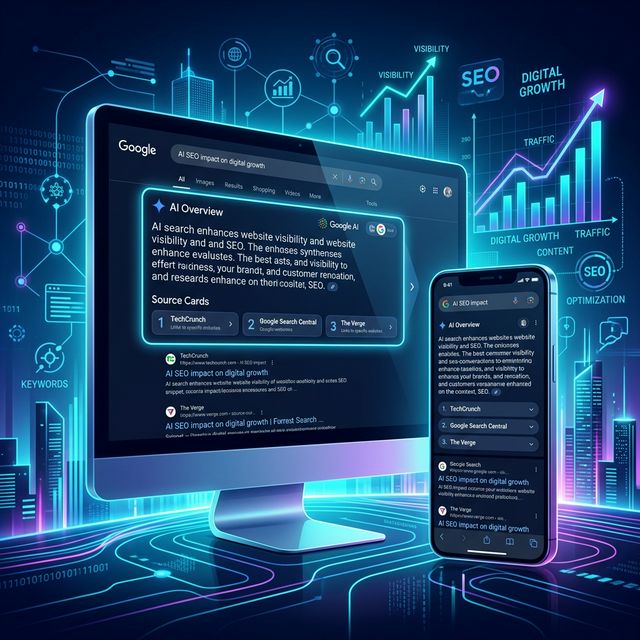
Google’s New AI Search Feature: What It Changes for Business Websites
Google AI Search is changing how customers discover information, businesses and products online. Here’s what businesses should understand about AI search, SEO and their website strategy.
Read More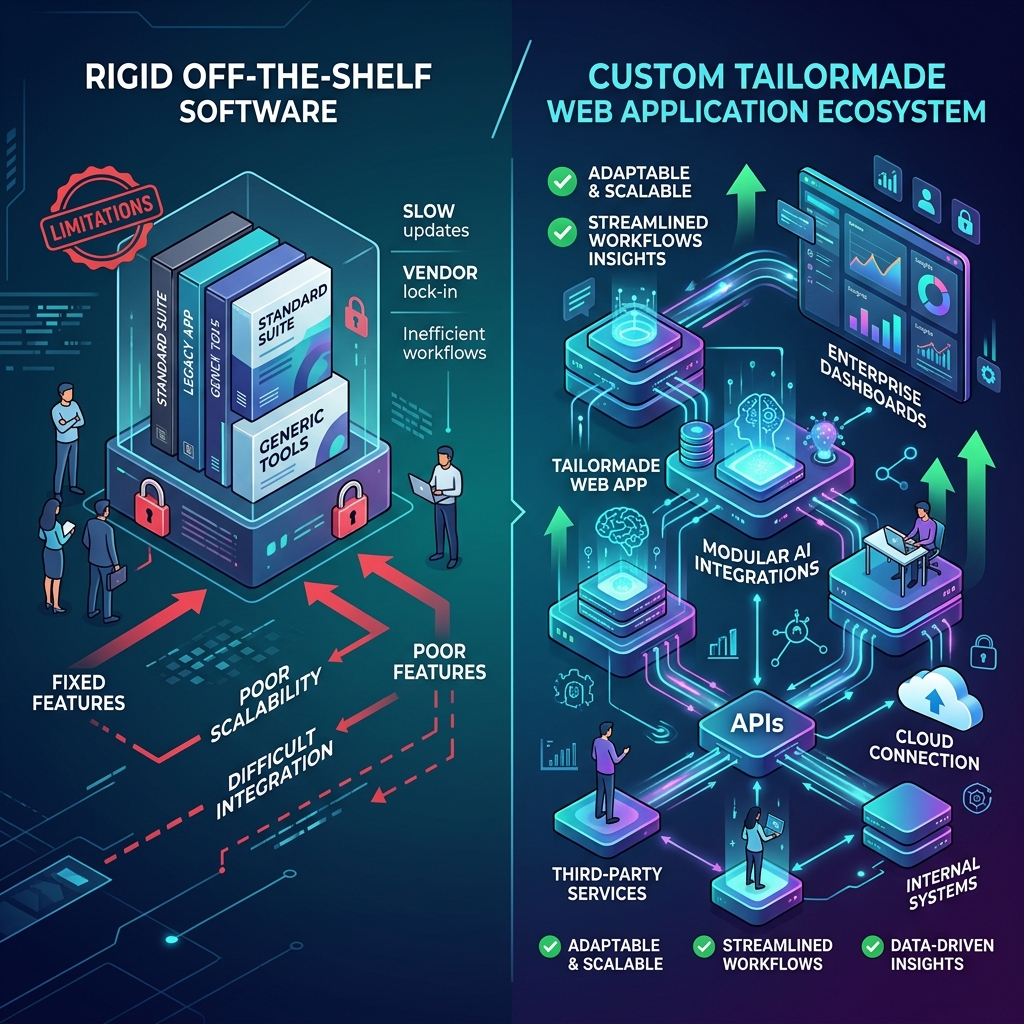
Why Businesses Are Moving from Off-the-Shelf Software to Custom Applications in 2026
Businesses are under constant pressure to work faster and adapt. Learn why organizations are switching from generic off-the-shelf software to custom applications built specifically around their workflows, AI, and growth plans in 2026.
Read More